
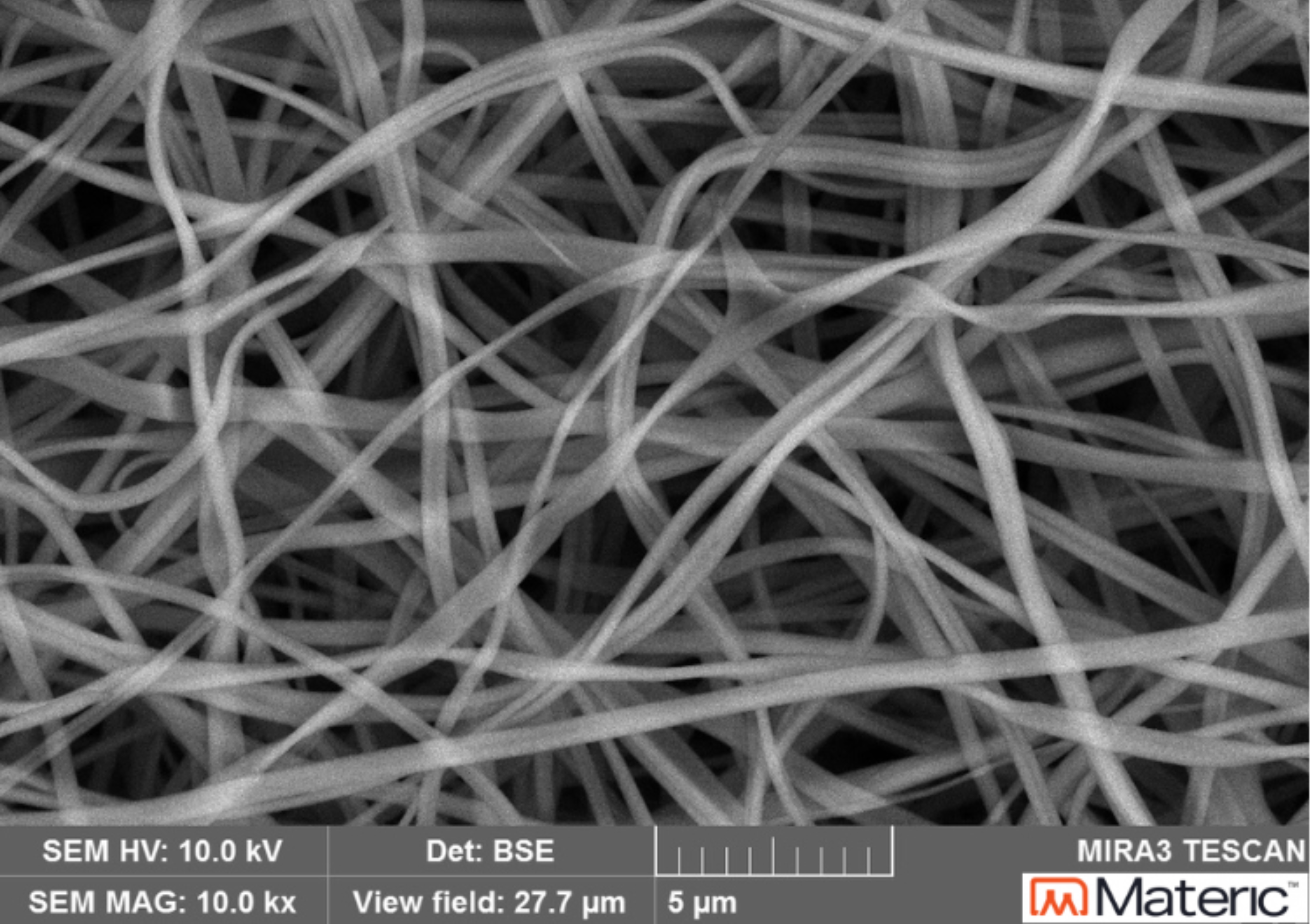



Materic’s Koyla Web™ carbon nanofiber (CNF) mats are produced via electrospinning. As an expert custom manufacturing organization (CMO), Materic utilizes electrospinning as an efficient and highly customizable process to produce inexpensive nanofibers with high surface area to volume ratio, and outstanding mechanical properties. The Koyla Web™ carbon nanofibers have wide ranges of applications from forming composites for aviation materials to making up gas diffusion layer (GDL) for proto-exchange membrane (PEM) fuel cells in renewable energy sector.
Koyla Web™- Carbon Nanofiber Mats
$250.00
Description
Order a carbon nanofiber mat sample (5 cm x 10 cm) in one of three options above. Or contact us to customize carbon nanofibers to your specific needs.
Carbon Nanofibers (CNFs) are conductive materials with electronic structure similar to graphite. CNFs have high electrical and thermal conductivity, which can be imparted to a wide range of matrices including thermoplastics, thermosets, elastomers, ceramics, and metals. Carbon nanofibers also have a unique surface state, which facilitates functionalization and other surface modification techniques to tailor/engineer the nanofiber to a host polymer or application.
Materic’s Koyla Web™ carbon nanofiber (CNF) mats are produced via electrospinning. As an expert custom manufacturing organization (CMO), Materic utilizes electrospinning as an efficient and highly customizable process to produce inexpensive nanofibers with high surface- area-to-volume ratios and outstanding mechanical properties. The Koyla Web™ carbon nanofibers have a wide range of applications, from forming composites for aviation materials to serving as gas diffusion layers (GDLs) for proton-exchange membrane (PEM) fuel cells in the renewable energy sector.
Order a carbon nanofiber mat sample (5 cm x 10 cm) in one of three options below. Or contact us to customize carbon nanofibers to your specific needs.
Will ship approximately 4 weeks after order is placed.
What Is Electrospinning?
Electrospinning is a common and industry established production method that uses the electric field to make nanofiber materials at scale. A fundamental electrospinning process consists of the polymer to be made into the final nanofiber, the solvent to dissolve the polymer, an electric source, a carrier (often a syringe) for the polymer solution, and a substrate to collect the nanofibers with a ground for the electrical field (see blow). In a common setup, the polymer solution is pushed out by a syringe, which is electrically charged, creating an electrical field together with the grounding substrate. The electric force from this electrical field pulls the solution from the syringe; the solvent evaporates while traveling from the syringe tip to the substrate and only the polymer deposits onto the substrate in thin nanofibrous form.

These electrospun nanofibers have a variety of applications, from conductive fibers that could be used for smart textiles or facilitate cell growth and tissue engineering to carbon nanofibers that could be fuel cell membranes or airplane composites. Electrospinning is a scalable and elegant way to make rolls of high value advanced materials.


